Isn’t “hack” a bad word?

This past weekend I led another soft circuits 101 workshop as a Mozilla Rep at a women’s music festival near SF called Fabulosa. I had one hour to teach people really basic electricity, circuits, and how to ‘hack’ their clothes/sculptures/lives with a 3V battery and some LEDs.

The reason I love to do this workshop is because I find it gives participants a physical representation of the hacker spirit Mozilla aims to embody for the web.  Learning soft circuits is just the tip of the iceberg and I always stress that the web has much more info for them to continue exploring, learning, being curious about how to create and modify technology in their lives.  In one hour, I just show them how to make light.

This workshop was smaller than the ~80 girls who came through at Dare 2B Digital.  The festival setting meant there were more conflicts of interest so I had 6 participants instead of the 20-25 I had planned for. The 6 participants were all very enthusiastic though, and we started off with a go-around to hear why people were interested in learning soft circuitry.  One person was hoping to learn how to light up her clay sculptures, another wanted to make art for Burning Man, and a few had costume ideas in mind.
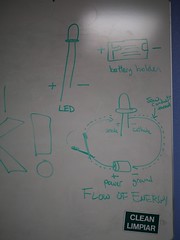
I spent the first 10-15 minutes explaining electricity, how a circuit works, and what kind of circuit they would be creating with their 3V batteries and LEDs – their circuits would be made using conductive thread sewn into felt (or some other material if they brought it).  With only 40 minutes left, we got to work – everyone started in on their first circuit.

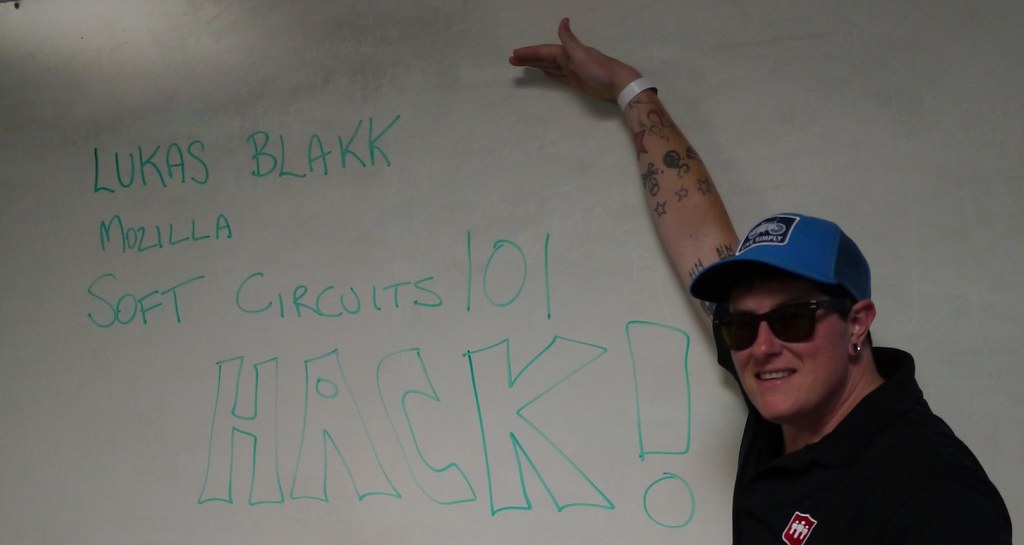
While we were casually chatting during the building time, one woman said “I thought ‘hack’ was a bad word” (I had written a large “HACK” on the whiteboard to inspire).  I’m so glad she brought this up and we had a chance to discuss the very reason for workshops like these, and for Mozilla. I explained to her that while it might once have been a vilified term, it has now been largely reclaimed as people work to make sure that they have full ownership of the things they buy, or make.  Encouraging people to open their minds up to the potential of hacking their lives – whether on the web or in the physical world – always feels great.  I was happy that even in this small gathering, we got to discuss this very key issue for technology going into the future, and that there are now 6 new hackers in the world.


App Marketplace Ratings

Woot!  Our recently release re-vamp of Firefox for Android is climbing the Top Free chart over on the Google Play Store (as it should, it’s frickin’ awesome).  We’ve gone from #96 to #81 in the past 3 days and I have no doubt we will continue to climb as we gain users and get a chance to impress them with the Native UI which is responsive, beautiful, and support Flash.  Our rating in the store is also slowly climbing, but that’s going to be a much harder slog because our current rating still reflects the total collected in the entire life of this product being on the store.  We can’t remove ratings from our previous Firefox for Android and so even though we’ve had 5,000 5-star reviews in the first 10 days of the re-written version being online, our average rating is a 3.7. The only way to get a fresh start would have been to put up a ‘new’ product and call it something else and I’m sure you can understand that Firefox can’t go by any other name.

I spend a lot of time thinking about the Google Play store and how it could be better because I interact with its administrative backend regularly, uploading new builds of the mobile products release after release.  I was just sitting through a presentation by Dees at ReMo Camp 2012 in Berlin and he was sharing with us the strategies behind the Mozilla Marketplace. This will be our open-source contribution to mobile/desktop app distribution and seeing the mockups started me thinking about how we could improve the rating system and not just repeat what Google and Apple do with user feedback.

I’d like to see the following:

  1. User leaves rating, gives stars + writes text feedback
  2. App developer can select reviews to flag as ‘bug report/feedback’ which requires them to write text that will be presented to the user.  The developer can write a message either letting the reporter know that a bug is on file now for the issue or provide help with the issues/questions raised by the user.
  3. User gets a notification when the review is flagged and that there is a response ready for them. They can check out the bug report that got filed as a result of their feedback and perhaps they will cc themselves to know when it gets fixed or they might get a chance to try out the suggested solutions from the dev to deal with issues or questions they raised in their original review.
  4. User, now that they have gotten feedback, gets prompted to revise their review.
  5. Repeat 1-4 as needed

This would be beneficial for many reasons:

  • Users get to be a part of helping improve the product
  • Users get support from the developer without needing a different forum or login
  • Users get visibility into software development process, awareness of upcoming features & improvements, and they become participants in open source community
  • App developers have a channel to communicate with users about upcoming dev plans, feature requests, and bug tracking
  • App developers get a collected feedback average that is more accurate and representative
  • App developers have a channel to communicate with users about upcoming dev plans, feature requests, and bug tracking

I’m used to Mozilla’s collaborative environment, the values of open source, and I’m accustomed to getting feedback in our open bug tracker, Bugzilla.  There are so many companies whose products I use who do not have public bug trackers and this causes me a lot of frustration when I find bugs with their software.  I want to tell their devs about the bugs I find.  Software has bugs!  Have a bug tracker! Let people see and understand that software is a continuous improvement process so we get less reviews like this:

firefox feedback in google play store, lamenting the lack of tablet support

I’d love to let Brian know that we are sooooo close to having our tablet support ready, that we have a few outstanding bugs but it’s on-track to ship with Firefox 15 in a mere 7 weeks. We’re a tiny team compared to the Gopplesoft mobile dev teams, give us a chance to prioritize and push each goal to the finish line. With only 20% of our Firefox mobile users on tablets, we had to focus on the 80% small device folks first and then – remember, only 8 weeks later – we got our tablet ducks in a row and ready for our fabulous tablet users.

Alex should get to see a bug filed on the pinch zoom (if there’s not already one) and as one of the admins of the Firefox product, I should get a chance to interact with the folks who leave 1 or 2 star reviews since they are often based on one or two issues that are real but fixable.  I want our rating to be reflective of the work we do as we do it, incrementally improving over time. Of course, our marketplace code is open source so I suppose I should do what Paul Rouget suggested earlier today and make up some prototypes 🙂

Tomahawk does many things right

Not too long ago I first heard of Tomahawk at one of our Mozilla Monday meetings – they’ve been working with our WebFWD initiative which supports open web projects that are moving the web forward.  Tomahawk definitely fits the bill for what the future of the web should be: music just plays.  Social, distributed, easy access to tunes through all the open APIs available – I can’t even begin to say how happy I am to be finally able to use this software.

I say ‘finally be able to use it’ because when I first heard of Tomahawk and ran to their site to download it, I stopped in my tracks.

Their original logo was a stereotype cartoon of a North American Indian male, wearing headphones.  I’ll let you do your own research if you want to learn why such a depiction isn’t culturally sensitive because that’s not actually the point of this post.  The point is that the people behind Tomahawk did constructive criticism a solid.  When, as a potential user, I saw this logo and took action by emailing them asking them to consider changing this inappropriate and stereotyping imagery as their masthead and application icon they said other people had contacted them as well, so they were aware and they were WORKING ON A NEW LOGO.

They didn’t get defensive, they didn’t say “we don’t see a problem here”, they didn’t try to justify their choices and protect their precious artwork.  They were already working on a solution, continuing forward momentum, adapting as they went, and being civil about it to boot. Who knows how many people contacted them? I might have been the thousandth and yet there was no hint of snark or beleaguered engineer who just wants to write software and not deal with all this soft, people-facing stuff in the response I got from Jason Herskowitz.  Thank you for that, Jason and Tomahawk.  I really hope this level of maturity catches on in the startup culture.

To give you an idea of how quickly they rotated on this; I emailed on May 14th and the new logo went into place today.  That’s slightly more than a month to revamp their site and update their installer and god knows what else (maybe business cards? stationary? do people still use that?).  This change isn’t trivial, but neither is the impression that original logo makes about a company.  I will proudly go forth now and rally support for this product that I have no doubt is stellar. I’ve been using it for the last 10 minutes since getting the email that the new logo was in place and let me tell you: setup was a breeze. I can also share this experience as a positive one with regards to taking the time to contact a company and point out a culturally insensitive aspect and seeing effective, mature, and expeditious resolution on that issue.  This is still rare enough to deserve an entire blog post.  I look forward to a future where this sort of thing is a more common dialogue and is always met with positive change and continued forward momentum instead of stop-energy and defensiveness.

Here’s the plug now:  Get Tomahawk!  It’s open source!  It will work with many, if not all, of your current web music accounts!  Support the open web and companies that move it forward!