Money for Nothing, and the Chicks (work) for Free

Ada Initiative reached its goal fundraising banner

Fundraising is almost as hard for me as self-promotion.  In fact, it’s easier for me to do the broadcasting I did around the Ada fundraising than I imagine it would be for me to do my own seed round for an idea I felt excited about.  I express with regularity how grateful I am for the people who practice social work in our society, doing outreach to the outcasts & downtrodden. I am also ever so thankful for people who can ask more times than I for contributions to important causes. No matter how valiant the mission, it’s such redundant communication, keep-your-chin-up, bright-siding, and a task this introvert, who merely has bouts of extroversion, finds very taxing.  So major kudos, fireworks, and many many pats on the back to Val Aurora and Mary Gardiner who held their own idea up and asked repeatedly for community contributions to support its very bright future. Thanks are due in advance for what they will continue to do now that there are some funds, to move forward and amplify the mission of getting more women, empowered women into all levels of Open Source communities.

I’ve observed that all these self-starting, entrepreneurial men act *entitled* to having people (often other men) throw (and put at risk) huge wads of cash on barely-developed ideas that appear promising on the surface.  And don’t a huge percentage of them fail?  And don’t many of those same men dust themselves off, move on to their next idea, and run the same game again?

Now, there’s some major class privilege here – these are generally very privileged men we are talking about. Men who have various safety nets, and often no dependents. Also they are the golden boys of capitalism (especially right now, and especially in the Bay Area) and that type of money lending/growing is not our game at orgs like the Ada Initiative.

BUT.

When it seemed like the Ada Initiative’s fundraising goals wouldn’t be met, I found myself questioning the expectation of the Ada Initiative to get funds, to be a ‘we pay people’ organization.  There is a lot of messaging out there that tells women who care about outreach and diversity initiatives that this work should be extra, volunteer, and passion-driven (and can’t you just eat passion for breakfast?) kind of work.  I had to look hard to double-down my resolve to believe in (and broadcast) the opposite.  We should be able to ask for this, expect it, drive this point home repeatedly WITHOUT SHAME.  At this point I don’t care if someone thinks we’re asking too much, too often and I have not yet actually HEARD someone say that, I just made it up in my head. Then I had to notice it, and figure out how to tell that voice to shut the fuck up.

So here’s what I tell myself (and the other Ada Initiative advisers on our mailing list):

  • What you’re doing matters.
  • You should get paid for doing it.
  • You’re creating tremendous value.
  • It is fair to ask people to kick back a portion of their income (esp. earned in the tech industry) to help with outreach and diversity efforts.

The point of sharing my internal voice re-write here, and pointing out how others manage to do it without shame when working on capitalist models is to say:

As much as humanly possible (and your strength to do so will vary day to day, understandably) – please fake it.  Fake that sense of entitlement.  Pretend sometimes that you’re one of those guys who think people should give you millions just cause you made some little piece of plastic on a 3-D printer and you’re going to take your idea over to China and mass-produce more plastic for people who make too much money to buy from you in droves.  Fake that confidence as much as you can until it’s real – because our mission sure as hell is and the value of this project is bigger than their million-dollar, landfill-feeding crap any day.
Why isn’t Autoland working?

This question comes up enough that I figured a quick blog post/status update would be helpful.

What does Autoland do?

Poll individual Bugzilla bugs for an autoland token (currently using whiteboard tags, future Autoland has an extension & webservice that makes polling the entirety of bugzilla no longer needed). When an autoland request is found, the serviced does an automated landing to try for you of all non-obsolete patches attached to the bug if they can be landed cleanly on tip of mozilla-central and either the patch author or a feedback provider have appropriate hg permissions, otherwise it reports back to the bug what the issues were. Upon completion of the try run, a comment is left in the bug stating the results and if a final repo destination (or destinations) was specified (the hg permissions must match up between requester/reviewer and the destination repo(s)) the service can continue on to autolanding the patch(es) to the destination repo.  A comment would be left on the bug when the push to final destination(s) is done.  There would be no reporting back of final build results, that would be handed back over to human eyes on TBPL.

What is Autoland’s status now?

In April of 2012, right before Marc’s second internship ended, we launched a very experimental public-facing version of Autoland and announced it a bit so we could get more people testing it.  This had varying degrees of success.  We got more bugs ironed out but also discovered that Autoland’s daemons for hgpushing and bugzilla polling tend to fall over a bit too often.  When we moved Autoland off it’s staging VM to a more permanent home we lost the status page that would tell us (and developers) what the modules were doing and that really made the workings of Autoland quite opaque.  With Marc leaving at the end of April and my switch over to help with Release Management in Feb 2012  I had kept meeting regularly with Marc and driving the project to completion as much as possible but hadn’t been able to pull my weight on coding for the last 3 months of our time together. This left us with an Autoland that stopped working and no one available to continue to massage it into being the robust system we needed it to be.  I took mention of Autoland out of our trychooser page, try server docs, and have generally tried to downplay it’s existence while still keeping a plan on the back burner for how we will resurrect it as soon as there is some time.

What does Autoland need to be publicly usable again?

  • A status page that can show what modules are running or down, display what’s in the queue, and give a quick visual to users if Autoland is up or down as a result.
  • Nagios alerts on the Autoland modules that let me (and other people interested in helping to maintain Autoland) know when things fall over.
  • At least one person, if not several, who can access the Autoland master VM and ‘kick’ it as needed

This is what’s needed for a short term solution. I know that we have some bugs with our hg pusher module as well as some trickiness in our message queue that, once fixed, would make the overall system more robust.  We need people using the system to be able to catch more of those bugs though, so in the meantime having as close to on-click restoring of the system would be a huge win here.

What does Autoland need to be truly ‘production’ ready?

  • Security review on the code and the BMO extension so that we can move away from whiteboard tags and let people use the BMO extension instead — this gives much cleaner input to Autoland of what is being requested.
  • More VMs to run hgpusher modules on so that Autoland can handle a larger load. Each VM can run 2 hgpushers max so we’d want to be able to grow our pushing farm as the usage of the system increases.
  • Being able to push to repos other than Try.

There is no clear plan to be able to get the system beyond Try landings, but I see automated try landings as still being a huge help so I’d be super happy just to see that part get back to a working state.  This project is no longer a RelEng priority now that I’ve permanently moved to Release Management and Marc has gone on to other internships and more schooling. I can’t promise anything time-wise, but I wanted to provide some clarity into what is needed and put out the “patches welcome” call.  I see Autoland as being a great option for a community-managed project and I want to keep working on it when time permits. If you are looking to become a Mozilla contributor and are interested in automation and web APIs – this might be a good starter project for you. Please get in touch.


Isn’t “hack” a bad word?

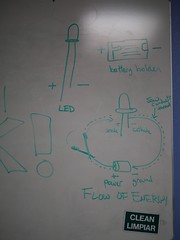
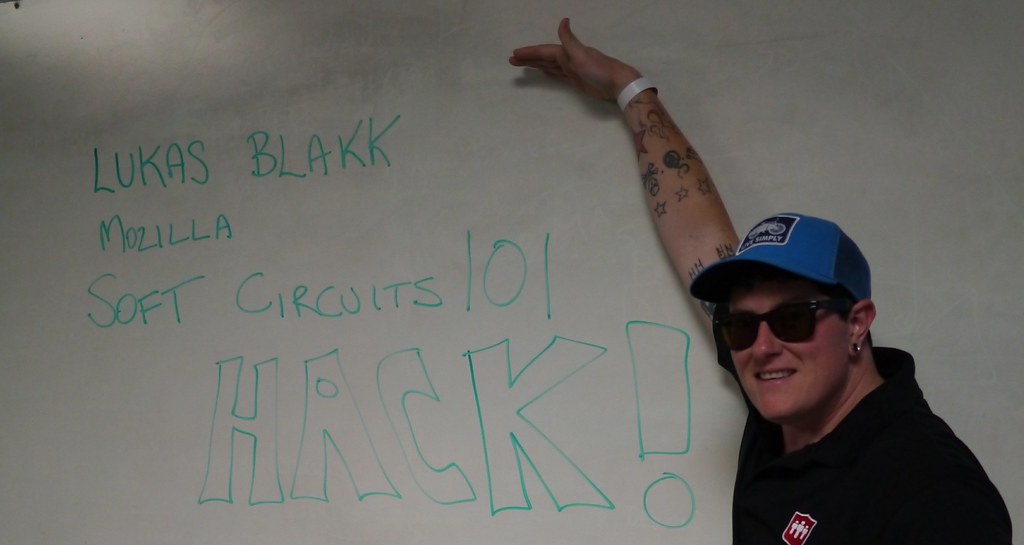
This past weekend I led another soft circuits 101 workshop as a Mozilla Rep at a women’s music festival near SF called Fabulosa. I had one hour to teach people really basic electricity, circuits, and how to ‘hack’ their clothes/sculptures/lives with a 3V battery and some LEDs.

The reason I love to do this workshop is because I find it gives participants a physical representation of the hacker spirit Mozilla aims to embody for the web.  Learning soft circuits is just the tip of the iceberg and I always stress that the web has much more info for them to continue exploring, learning, being curious about how to create and modify technology in their lives.  In one hour, I just show them how to make light.

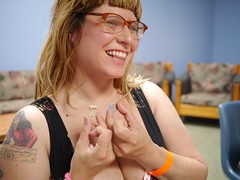
This workshop was smaller than the ~80 girls who came through at Dare 2B Digital.  The festival setting meant there were more conflicts of interest so I had 6 participants instead of the 20-25 I had planned for. The 6 participants were all very enthusiastic though, and we started off with a go-around to hear why people were interested in learning soft circuitry.  One person was hoping to learn how to light up her clay sculptures, another wanted to make art for Burning Man, and a few had costume ideas in mind.

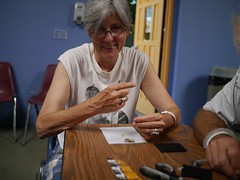
I spent the first 10-15 minutes explaining electricity, how a circuit works, and what kind of circuit they would be creating with their 3V batteries and LEDs – their circuits would be made using conductive thread sewn into felt (or some other material if they brought it).  With only 40 minutes left, we got to work – everyone started in on their first circuit.
While we were casually chatting during the building time, one woman said “I thought ‘hack’ was a bad word” (I had written a large “HACK” on the whiteboard to inspire).  I’m so glad she brought this up and we had a chance to discuss the very reason for workshops like these, and for Mozilla. I explained to her that while it might once have been a vilified term, it has now been largely reclaimed as people work to make sure that they have full ownership of the things they buy, or make.  Encouraging people to open their minds up to the potential of hacking their lives – whether on the web or in the physical world – always feels great.  I was happy that even in this small gathering, we got to discuss this very key issue for technology going into the future, and that there are now 6 new hackers in the world.